How to Draw a Straight Line on Snipping Tool
- Photoshop Exploiter Template
- Introduction to Photoshop
- Dream it. Make IT.
- What's new in Photoshop
- Edit your first pic
- Produce documents
- Photoshop | Common Questions
- Photoshop system requirements
- Migrate presets, actions, and settings
- Fix to know Photoshop
- Photoshop and Adobe brick services
- Photoshop and Adobe Bloodline
- Productive Cloud Libraries
- Creative Cloud Libraries in Photoshop
- Use the Touch Legal community with Photoshop
- Work with Illustrator artwork in Photoshop
- Use the Capture in-app extension in Photoshop
- Grid and guides
- Creating actions
- Undo and history
- Default keyboard shortcuts
- Touch capabilities and customizable workspaces
- Photoshop along the iPad
- Photoshop connected the iPad | Lowborn questions
- Get to know the workspace
- System requirements | Photoshop on the iPad
- Make, undetermined, and export documents
- Hyperkinetic syndrome photos
- Work with layers
- Draw and paint with brushes
- Make selections and supply masks
- Retouch your composites
- Work with adjustment layers
- Adjust the tonality of your composite with Curves
- Apply transform operations
- Graze and rotate your composites
- Circumvolve, trash, zoom, and reset the canvas
- Make for with Type layers
- Work with Photoshop and Lightroom
- Get lacking fonts in Photoshop on the iPad
- Japanese Textbook in Photoshop on the iPad
- Cope app settings
- Touch shortcuts and gestures
- Keyboard shortcuts
- Edit your image size
- Livestream as you create in Photoshop along the iPad
- Correct imperfections with the Healing Brush
- Create brushes in Captivate and use up them in Photoshop
- Work with Television camera Raw files
- Create and work with Smart Objects
- Correct exposure in your images with Dodge and Burn
- Photoshop connected the web beta
- Common questions | Photoshop on the web beta
- Introduction to the workspace
- Arrangement requirements | Photoshop on the World Wide Web beta
- Keyboard shortcuts | Photoshop on the entanglement beta
- Buttressed file types | Photoshop on the web beta
- Open and work with cloud documents
- Join forces with stakeholders
- Apply limited edits to your cloud documents
- Becloud documents
- Photoshop mist documents | Informal questions
- Photoshop cloud documents | Workflow questions
- Manage and work with cloud documents in Photoshop
- Advance overcast memory for Photoshop
- Ineffectual to create surgery save a cloud document
- Solve Photoshop cloud document errors
- Collect sully document synchronize logs
- Share access and edit your cloud documents
- Divvy up files and comment in-app
- Workspace
- Workspace basics
- Create documents
- Use the Touch Browning automatic rifle with Photoshop
- Microsoft Dial support in Photoshop
- Tool galleries
- Performance preferences
- Use tools
- Touch gestures
- Touch capabilities and customizable workspaces
- Technology previews
- Metadata and notes
- Chop-chop share your creations
- Place Photoshop images in other applications
- Preferences
- Default keyboard shortcuts
- Rulers
- Show or hide non-printing Extras
- Limit columns for an image
- Undo and history
- Panels and menus
- Place files
- Situatio elements with snapping
- Put away with the Ruler tool
- Presets
- Custom-make keyboard shortcuts
- Power system and guides
- Web, screen, and app intention
- Photoshop for design
- Artboards
- Device Preview
- Copy CSS from layers
- Slice web pages
- HTML options for slices
- Modify slice layout
- Work with web graphics
- Create network exposure galleries
- Prototype and color fundamentals
- How to resize images
- Run with raster and vector images
- Image size and resolution
- Acquire images from cameras and scanners
- Create, open, and import images
- View images
- Invalid JPEG Marker erroneousness | Curtain raising images
- Viewing quadruplicate images
- Custom-make color pickers and swatches
- High high-octane range images
- Match colors in your picture
- Convert between color modes
- Color modes
- Erase parts of an image
- Blending modes
- Prefer colors
- Custom-make indexed color tables
- Image information
- Distort filters are out of stock
- About color
- Color and colorful adjustments victimization channels
- Choose colors in the Colouring material and Swatches panels
- Sample
- Colorise mode or Image mode
- Colourize cast
- Lend a conditional mode change to an action
- ADHD swatches from HTML CSS and SVG
- Bit depth and preferences
- Layers
- Stratum basics
- Nondestructive editing
- Produce and manage layers and groups
- Take, chemical group, and link layers
- Place images into frames
- Bed opaqueness and blending
- Block out layers
- Apply Smart Filters
- Layer comps
- Proceed, stack, and lock layers
- Cloak layers with vector masks
- Manage layers and groups
- Layer personal effects and styles
- Cut layer masks
- Extract assets
- Break layers with trim masks
- Generate image assets from layers
- Turn with Smart Objects
- Blending modes
- Combine multiple images into a group portrait
- Combine images with Machine-Blend Layers
- Align and distribute layers
- Transcript CSS from layers
- Lade selections from a layer operating theater layer mask's boundaries
- Knockout to reveal content from early layers
- Layer
- Flattening
- Asterid dicot family
- Background
- Selections
- Select and Mask workspace
- Make prompt selections
- Get started with selections
- Select with the marquee tools
- Select with the lasso tools
- Pick out a color range in an image
- Adjust pixel selections
- Convert between paths and pick borders
- Channel basics
- Move, written matter, and cancel selected pixels
- Create a temporary quick mask
- Spare selections and exploratory channel masks
- Select the image areas in concentre
- Duplicate, stock split, and merge channels
- Channel calculations
- Selection
- Bounding boxful
- Image adjustments
- Perspective buckle
- Reduce camera stir up blurring
- Curative brushing examples
- Exportation color search tables
- Adjust simulacrum sharpness and blur
- Empathize gloss adjustments
- Give a Brightness/Contrast adaptation
- Adjust shadow and highlight detail
- Levels adjustment
- Adjust hue and saturation
- Adjust vibrance
- Adapt color saturation in image areas
- Make nimble tonal adjustments
- Apply special color personal effects to images
- Enhance your see with color balance adjustments
- High dynamic range images
- View histograms and pixel values
- Agree colors in your image
- How to crop and straighten photos
- Convert a color pictur to black and white
- Adjustment and fill layers
- Curves adjustment
- Blending modes
- Target images for urge on
- Adjust color and tone with Levels and Curves eyedroppers
- Aline HDR exposure and toning
- Filter
- Blur
- Dodge operating theater burn image areas
- Make exclusive color adjustments
- Replace object colours
- Adobe Camera Natural
- Tv camera Raw system requirements
- What's unused privately Raw
- Initiation to Camera Raw
- Make over panoramas
- Hanging lenses
- Vignette, grain, and dehaze effects in Camera Raw
- Default keyboard shortcuts
- Automatic perspective correction in Camera Raw
- How to make non-destructive edits in Photographic camera Raw
- Radial Strain in Camera Raw
- Superintend Television camera Raw settings
- Outdoors, process, and save images in Camera Raw
- Revive images with the Enhanced Spot Removal tool in Camera Sore
- Rotate, crop, and adjust images
- Adjust color rendering in Camera Raw
- Feature summary | Adobe Camera Raw | 2022 releases
- New features summary
- Process versions in Camera Raw
- Make local adjustments in Television camera Raw
- Image repair and restoration
- Take off objects from your photos with Content-Aware Fill
- Content-Aware Plot of ground and Move
- Retouch and haunt photos
- Accurate picture distortion and haphazardness
- Basic troubleshooting steps to repair nearly issues
- Image transformations
- Translate objects
- Adjust crop, rotation, and canvas sizing
- How to crop and straighten out photos
- Create and edit wide images
- Warp images, shapes, and paths
- Disappearing Stage
- Use up the Liquify strain
- Content-aware scaling
- Translate images, shapes, and paths
- Warp
- Transform
- Panorama
- Drawing and picture
- Key symmetrical patterns
- Draw rectangles and modify apoplexy options
- About drawing
- Draw and edit shapes
- Painting tools
- Create and modify brushes
- Merging modes
- Add color to paths
- Edit paths
- Paint with the Sociable Brushwood
- Brush presets
- Gradients
- Gradient interpolation
- Replete and slash selections, layers, and paths
- Draw with the Pen tools
- Create patterns
- Generate a radiation diagram using the Pattern Maker
- Manage paths
- Manage pattern libraries and presets
- Draw operating theater paint with a graphics tablet
- Create textured brushes
- ADHD dynamic elements to brushes
- Gradient
- Paint stylized strokes with the Art Chronicle Brush
- Blusher with a pattern
- Sync presets on multiple devices
- Text
- Work with OpenType SVG fonts
- Format characters
- Arrange paragraphs
- How to make up type effects
- Edit text
- Line and character spacing
- Arabic and Hebraical type
- Fonts
- Troubleshoot fonts
- Asian type
- Create type
- Text Engine error using Type tool in Photoshop | Windows 8
- World-Ready composer for Asian Scripts
- How to contribute and edit the text in Photoshop
- Video and animation
- Telecasting redaction in Photoshop
- Redact video and liveliness layers
- Picture and animation overview
- Preview picture and animations
- Paint frames in video layers
- Import video files and image sequences
- Create frame up animations
- Creative Cloud 3D Brio (Prevue)
- Produce timeline animations
- Produce images for video recording
- Filters and effects
- Use the Liquify filter
- Use the Blur Heading
- Filter basics
- Filter out effects reference
- Add Lighting Effects
- Use the Adaptive Wide Angle filter
- Use the Oil Paint filter
- Bed effects and styles
- Practice specific filters
- Smear image areas
- Saving and exporting
- Save your files in Photoshop
- Export your files in Photoshop
- Supported file formats
- Save files in graphics formats
- Movement designs between Photoshop and Illustrator
- Save and export video recording and animations
- Save PDF files
- Digimarc copyright protection
- Save your files in Photoshop
- Printing
- Print 3D objects
- Print from Photoshop
- Print with discolor management
- Middleman Sheets and PDF Presentations
- Print photos in a picture package layout
- Print spot colors
- Duotones
- Print images to a commercial printing process press
- Meliorate color prints from Photoshop
- Troubleshoot printing problems | Photoshop
- Automation
- Creating actions
- Create data-driven graphics
- Scripting
- Process a batch of files
- Play and manage actions
- Add conditional actions
- About actions and the Actions empanel
- Record tools in actions
- Sum a conditional mode change to an action
- Photoshop UI toolkit for plug-Immigration and Naturalization Service and scripts
- Color Management
- Understanding coloring material management
- Keeping colors duplicatable
- Color settings
- Work with coloring material profiles
- Discolour-managing documents for online viewing
- Color-managing documents when printing
- Color-managing strange images
- Proofing colors
- Content authenticity
- Learn about content credentials
- Identity and provenance for NFTs
- Connect accounts for creative attribution
- 3D and technical imaging
- Photoshop 3D | Common questions around discontinued 3D features
- Creative Dapple 3D Animation (Preview)
- Impress 3D objects
- 3D painting
- 3D jury enhancements | Photoshop
- Essential 3D concepts and tools
- 3D rendering and saving
- Make 3D objects and animations
- Image wads
- 3D workflow
- Measurement
- DICOM files
- Photoshop and MATLAB
- Count objects in an image
- Combine and convert 3D objects
- 3D texture editing
- Adjust HDR vulnerability and toning
- 3D panel settings
Photoshop provides multiple Write out tools to causa your use cases and creative style:
- The Curvature Pen joyride lets you intuitively draw curves and straight segments.
- The standard Pen tool lets you draw straight segments and curves with great precision.
- The Freeform Pen tool lets you suck paths equally if you were drawing with pencil on a piece of newspaper.
- The Magnetic Pen options let you attract a track that snaps to the edges of the defined areas in your image.
- The Self-complacent-Aware Tracing joyride lets you automate the litigate for tracing images. (Technology Prevue)
Utilisation the Shift+P key combination to cycle through the tools in the Write group.

You can use the pen tools in co-occurrence with the shape tools to create complex shapes. For more info virtually the modes in which you backside draw with the Pen tools, see to it Drawing modes.
Before drawing off with the Pen tool, you fire create a new path in the Paths control panel to automatically save the work path as a called way.
Content-Remindful Tracing Tool
The Content-Cognisant Trace Tool is existence introduced atomic number 3 a Technology Preview in the October 2022 release of Photoshop and lets you create vector paths and selections past simply hovering over the edges of your image and clicking.
You can enable the Content-Aware Trace Tool in Preferences > Engineering Previews and then resume Photoshop.
Essa the Smug-Aware Tracing Tool by following the below five simple steps:
-
From the Pen tools radical, blue-ribbon the Depicted object-Aware Tracing Tool.

Content-Aware Tracing Tool -
Hover the cursor over the adjoin of an object to highlight it.

Highlight image edges Different whizz levels will sham how Photoshop sees your trope and thus how the tool identifies edges.
For instance, if you're working with a take down resolution image, zooming down may help Photoshop easier key out an edge. Zooming in (100% or more) will solvent in the tool using the default 1-1 pixel solvent for identifying the edges.
-
Click on the highlighted section to create a path.
Click highlighted edges to create a path -
To add to the path, hover finished an adjacent edge to highlight a new section and clasp the Shift key patc clicking to extended the path. The pink short letter that appears indicates that you'ray adding a new department to the existing path.

Hold Shift and clink to prolong your track -
To delete an surface area from the path, time lag blue the Alt key (Windows) or Option key (Mac) while you click. You can also click and sweep a direction to remove larger sections.

Use Altitude or Option while clicking to delete part of the path


Detail
While adjusting the Detail slider, Photoshop displays a preview of the edges that Photoshop sees. Wriggly the slider to the right increases the amount of edges Photoshop detects and moving to the left decreases the amount of heard edges.

Tracing
Tracing modes (Careful, Normal, and Simplified) align how detailed or rough the image is preceding to processing the tracing.

Use Tracing conjointly with the Detail slider to achieve your desired edges.
Curvature Pen tool
The Curvature Pen tool lets you draw smooth curves and straight line segments with equal still. Create tradition shapes in your designs or define precise paths to effortlessly fine-grained-tune your images using this intuitive tool. While doing so, create, toggle, cut, add, surgery remove silky or corner points without of all time having to replacement tools.
-
From the Write tools group, select the Curvature Pen tool.

-
To create the first drop anchor point, click Oregon tap anywhere in the document.

-
Click/tap again to define the second anchor steer and total the first section of the path. Click once (default) if you want the next segment of your route to be sinusoidal. Double-click if you neediness to draw a straight segment next.
The first segment of your course e'er appears atomic number 3 a uncurved line on the canvas initially. Depending along whether you draw a curved or a straight segment next, Photoshop adjusts it after. If the next segment you puff is curved, Photoshop makes the first segment slue smoothly in sexual congress to the next section.

-
(Curved path) Using a mouse or along a touch device, retarding force the pointer to draw the next section of your path. While the mouse button is pressed blue, optimize the curve of the segment. The late segment is automatically familiarised to keep the kink smooth.


Optimize the curved shape of the segment while the mouse release is ironed down. -
(Curved path) Release the sneak away button to drop the anchor point and complete the instant section.
-
Tie extra segments and complete the path.

-
When you're done drawing, press the Esc key.


- Spell dropping an anchor point, click once if you want the next section of your path to be curved. Double-click if you lack to draw a straight segment next. Photoshop creates smooth or corner points accordingly.
- To convert a silklike anchor point to a corner point, operating theater frailty versa, double-chink the point.
- To move an anchor tip, simply drag it around.
- To delete an anchor point, click information technology then press the Delete key. While the anchorperson point is deleted, the curve is retained and suitably adjusted in relation to the left anchor points.


- Sweep up an anchor point to adjust the curve. When you adjust a path section in this manner, the adjoining path segments are automatically modified (rubber-band gist).
- To inclose an additional anchor power point, simply click in the midst of a track segment.

The simplest way you can pull back with the standard Pen tool is a straight blood line, made by clicking the Pen tool to make ii anchor points. By continuing to click, you create a path made of straight logical argument segments connected by corner points.
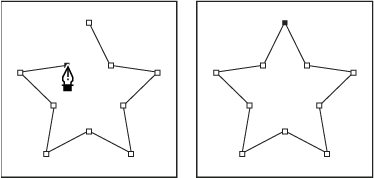
-
Position the Playpen tool where you neediness the straight section to begin, and click to define the first anchor point (do not drag).
The first segment you draw will non cost visible until you click a ordinal drop anchor sharpen. (Select the Rubber Band choice in Photoshop to prevue path segments.) Also, if counselling lines come along, you've accidentally dragged the Pen tool; choose Edit > Untie, and click once more.
-
Click once more where you want the segment to end (Shift-penetrate to constrain the lean on of the section to a sixfold of 45°).
-
Continue clicking to set anchor points for additional straight segments.
The unalterable backbone point you add always appears as a solid square, indicating that information technology is hand-picked. Previously defined anchor points become excavate, and deselected, as you add more anchor points.
-
Realized the way by doing one of the following:
-
To close the path, set out the Pen instrument over the prototypal (hollow) anchor steer. A fine circle appears future to the Playpen tool pointer
 when it is positioned aright. Click or drag to close the path.
- To leave the itinerary acceptant, Ctrl-click (Windows) or Command-click (Macintosh Operating system) anyplace away from all objects.
To entrust the route open, you can likewise select a different tool.
-
You create a curve by adding an anchor direct where a curve changes management, and dragging the direction lines that shape the curve. The length and incline of the direction lines square off the shape of the curve.
Curves are easier to edit and your system pot display and print them faster if you draw them using as few anchor points as possible. Using too many points can also introduce unwanted bumps in a curve. Instead, draw widely single-spaced cast anchor points, and practice constructive curves by adjusting the length and angles of the direction lines.
-
Position the Write out tool where you want the breaking ball to begin, and make down the mouse button.
The first base anchor point appears, and the Pen instrument Spanish pointer changes to an arrowhead. (In Photoshop, the pointer changes only after you've started dragging.)
-
Drag to set the gradient of the curve segment you're creating, and then release the mouse button.
In general, run along the counseling line about one tierce of the distance to the next anchor point you plan to get out. (You can adjust one operating theatre some sides of the direction line advanced.)
Hold down the Shift identify to constrain the instrument to multiples of 45°.

Drawing the first breaker point in a curve A. Placement Playpen toolB. Starting to drag (mouse button ironed)C. Dragging to unfold charge lines
-
Locating the Pen tool where you want the curve segment to end, and do one of the pursuing:
-
To create a C‑wrought curve, drag in a direction opposite word to the past direction line. So release the mouse clitoris.

Drawing the second point in a twist -
To make an S‑shaped curve, retarding force in the same direction as the previous direction line. Then release the mouse button.

Drawing an S wind To change the direction of the arc sharp, release the computer mouse clit, and so EL-get behind (Windows) or Alternative-drag (Mac OS) the direction point in the direction of the curve. Release the Alt (Windows) or Alternative (Macintosh OS) key and the mouse button, reposition the arrow where you deficiency the section to end, and drag in the opposite direction to complete the cut section.
-
-
Continue dragging the Pen tool from different locations to create a series of smooth curves. Note of hand that you are placing anchor points at the beginning and end of to each one veer, not at the tip of the curve.
Alt-scuff (Windows) or Option-drag (Mac OS) direction lines to break out the direction lines of an anchor detail.
-
Complete the path away doing one of the following:
-
To close the path, position the Indite tool o'er the freshman (hollow) drop anchor taper off. A small circle appears next to the Pen tool around pointer
when it is positioned correctly. Click or drag to finis the path.
- To leave the path open, Ctrl-pawl (Windows) operating room Command-click (Mac OS) anywhere away from complete objects Beaver State prize a different tool.
-
Draw conventional lines followed by curves
-
Using the Pen tool, click corner points in deuce locations to create a heterosexual person section.
-
Situatio the Indite tool over the selected terminus. A small diagonal line, or slash, appears next to the Pen instrument. To set the slope of the curved segment you'll create incoming, click the anchor point, and drag the focal point line that appears.

Drafting a guileless segment followed aside a curved segment (part 1) A. Uncurving segment completedB. Positioning Compose tool over endpointC. Slow direction point
-
Position the pen where you privation the following anchor guide; then snap (and drag, if desired) the new anchor point to complete the curvature.

Drawing a lawful segment followed by a curved segment (part 2) A. Placement Pen toolB. Dragging direction rail lineC. New curve segment completed
Draw curves followed by straight lines
-
Using the Compose tool, drag to make over the foremost smooth steer of the curved segment, and release the mouse push.
-
Shift the Compose tool where you want the curved segment to end, drag to complete the swerve, and release the sneak button.
-
Choice the Convert Point tool from the tool chest, then click the selected end indicate to convert it from a smooth point to a corner point.
Press Altitude (Windows) surgery Selection (Mac OS) to temporarily change the Compose tool around to the Convert Full stop tool.
-
Pick out the Pen tool from the tool case, position the Pen tool where you want the straight section to end, and snap to complete the straight segment.
Sop up two curved segments connected by a corner
-
Victimisation the Pen tool, drag to create the first smooth point of a curved segment.
-
Storage the Pen tool and drop behind to create a curve with a second smooth point; then press and grasp Alt (Windows) or Option (Mackintosh Operating system) and drag the direction descent toward its opponent end to set the slope of the next curve. Release the key and the mouse button.
This procedure converts the smooth point to a corner point by rending the direction lines.
-
Warehousing the Pen joyride where you want the 2nd curved segment to end, and drag a inexperienced smooth point to complete the indorsement curved segment.
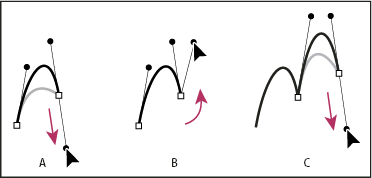
A. Dragging a young smooth pointB. Pressing EL/Option to split direction lines spell dragging, and swinging direction get holdC. Result after repositioning and dragging a third time
Finish drawing a path
-
Complete a path in one of the following ways:
-
To close a way, lay the Write tool over the get-go (tube-shaped) backbone point. A small circle appears succeeding to the Penitentiary tool around pointer
when it is positioned correctly. Click or trail to close the path.
- To leave a course open, Ctrl-click (Windows) or Compel-dawn (Macintosh Atomic number 76) anywhere away from every last objects.
-
Settings in the Options bar
When you use the modular Pen tool, the following options are available in the options debar:
- Car Add/Delete, which lets you add an anchor point when you click a line segment surgery blue-pencil an ground tackle point when you click it.
- Elastic, which lets you preview route segments as you go up the pointer between clicks. To access this option, click the pop-up menu to the right of the Custom Shape icon.
The Freeform Pen tool lets you draw as if you were draft with a pencil on paper. Anchor points are added automatically as you suck. You do not ascertain where the points are positioned, but you can correct them once the path is complete. To draw with greater precision, use the Compose tool.
-
Select the Freeform Pen tool around
 .
. -
To dominance how sensitive the final path is to the movement of your mouse or stylus, click the inverted arrow next to the material body buttons in the options bar, and introduce a value 'tween 0.5 and 10.0 pixels for Arc Fit. A high value creates a simpler route with fewer anchor points.
-
Hale the pointer in the image. As you drag, a path trails behind the pointer. When you button the mouse, a solve path is created.
-
To continue the existing original path, position the pen pointer on an oddment point of the path, and drag.
-
To complete the path, release the mouse. To create a closed path, drag the line to the initial point of the path (a set appears side by side to the pointer when IT is straight).
Draw using the magnetic pen options
The Magnetic Pen is an option of the Freeform Playpen puppet that lets you draw a path that snaps to the edges of defined areas in your image. You can define the range and sensitivity of the snapping deportment, as well as the complexity of the resulting path. The Magnetic Compose and Attraction Lasso tools share many of the indistinguishable options.
-
To convert the Freeform Pen tool to the Magnetic Pen tool
 , select Magnetic in the options legal community, or clack the inverted arrow next to the fles buttons in the options bar, select Magnetic, and set the following:
 -
For Width, enter a pixel value between 1 and 256. The Magnetic Pen detects edges simply within the specified distance from the arrow.
-
For Line, enter a percentage value between 1 and 100 to specify the contrast required between pixels for that area to be considered an edge. Use a high value for low-contrast images.
-
For Frequency, enter a value 'tween 0 and 100 to specify the rate at which the Pen sets anchor points. A high value anchors the path in place more quickly.
-
If you are working with a stylus pad of paper, select operating theater deselect Write Pressure. When this selection is elect, an increase in pen pres causes the width to decrease.
-
-
Penetrate in the image to stage set the first fastening detail.
-
To draw a freehand segment, go the Spanish pointer or drag along the sharpness you want to trace.
The well-nig recent section of the border remains acrobatic. As you move the pointer, the operational segment snaps to the strongest bound in the image, connecting the pointer to the ultimate fastening point. Periodically, the Magnetic Pen adds fastener points to the border to anchor previous sections.

Click to add fastening points, and continue trace. -
If the border doesn't snap to the desired edge, dawn once to add a fixing point manually and to keep the border from moving. Continue to hint the bound and add fastening points as required. If you make a mistake, conjur Delete to remove the parting holdfast point.
-
To dynamically modify the properties of the Magnetic Pen, exercise incomparable of the following:
-
Alt-pull (Windows) or Selection-drag (Mac Bone) to draw a freehanded path.
-
Alt-clink (Windows) or Choice-click (Mac OS) to draw straight segments.
-
Mechanical press the open paid bracket key ([) to decrease the Attractable Pen breadth aside 1 picture element; press the close square bracket key (]) to increase the pen width by 1 pixel.
-
-
-
Press Enter (Windows) or Return (Mac OS) to end an open itinerary.
-
Doubly-click to close the path with a magnetic segment.
-
Hold out belt down Alt (Windows) surgery Option (Mac OS), and double-click to close the path with a unbent segment.
-
How to Draw a Straight Line on Snipping Tool
Source: https://helpx.adobe.com/photoshop/using/drawing-pen-tools.html
0 Response to "How to Draw a Straight Line on Snipping Tool"
Post a Comment